
Reviewed · HISTORICAL TOURS
Private Historical Tour: Guangzhou City Sightseeing Including Lunch
Guangzhou has a way of hiding its big stories in plain sight, and this private day tour is a focused route through four of the city’s most memorable, very different landmarks. You’ll go from ornate ancestral halls to a massive underground royal tomb, then to giant Buddhist statues and a colonial island walk on the Pearl River.
I especially love the mix of China’s early imperial era and Cantonese craftsmanship, and I also like that your English-speaking guide helps connect what you see to why it matters. One thing to keep in mind is that it’s a full 8-hour flow with a moderate amount of walking, so it helps to wear comfortable shoes and keep your expectations realistic for a busy day.
Key Points You’ll Care About
- Chen Clan Temple to Folk Art Museum: see fine carvings and the museum displays of Cantonese craft
- Nanyue King Tomb underground chambers: a dramatic 65-foot belowground setting tied to royal burial artifacts
- Six Banyan Temple and Flower Pagoda: three huge copper Buddhas plus a Yuan Dynasty cast copper top
- Shamian Island walk: colonial-era mansions and churches feel worlds away from the modern city
- Lunch included: a traditional Chinese style meal breaks up the day with local flavor
- Private vehicle, hotel pickup: you spend less time figuring out transport and more time seeing sites
Why This Guangzhou Route Works So Well in One Day
This tour is interesting because it’s not just a checklist of famous spots. It’s built around a theme: Guangzhou’s long timeline, from imperial power to religious life, and then the city’s later links to Western trade and settlement on Shamian Island.
You’ll get a clear order to your day, starting with the Chen Clan Ancestral Hall and moving toward the Nanyue King Mausoleum on Xianggang Hill. After that, you shift into Buddhist and architectural highlights at Six Banyan Temple and the Flower Pagoda. Then you finish with a slower, more human-scale walk on Shamian Island, plus optional time for shopping along Shangxiajiu Pedestrian Street.
The private setup matters here. Guangzhou is huge, and with English not being the default, having a guide plus a driver means you avoid the mental load of planning between scattered sites. People I’ve talked to during past trips often say the same thing: the value is not only what you see, it’s how smoothly the day runs.
More history days in Guangzhou:
- UNESCO Watchtowers World Heritage Ancient Villages Private Tour
★ 5.0 · 17 reviews - Guangzhou: Cantonese Heritage Tour with Key Cultural Stops
★ 5.0 · 13 reviews - All Inclusive Kaiping Diaolou Heritage Private Day Trip from Guangzhou
★ 5.0 · 5 reviews
Chen Clan Ancestral Hall and the Guangdong Folk Art Museum
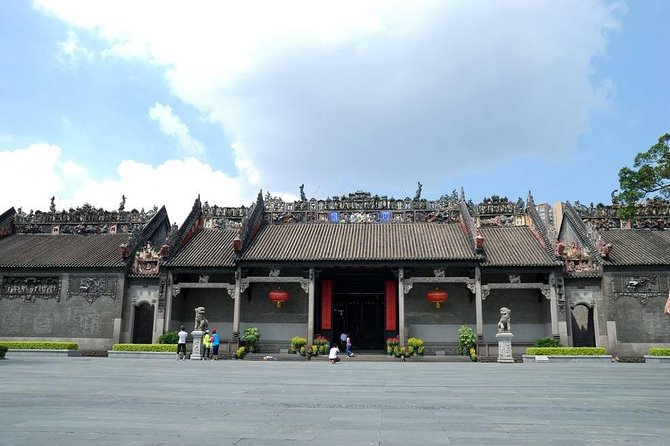
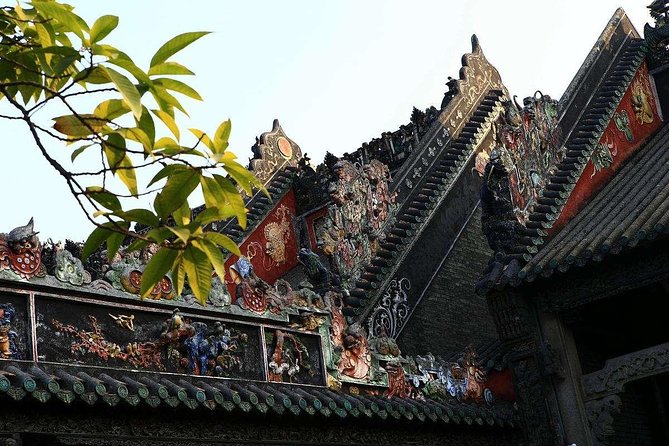
Your first major stop is the Chen Clan Temple, also known as the Chen Family Academy. It was built from 1890 to 1894 for ancestral worship, so even before you enter, you’re stepping into a building that was designed for ceremony, memory, and status.
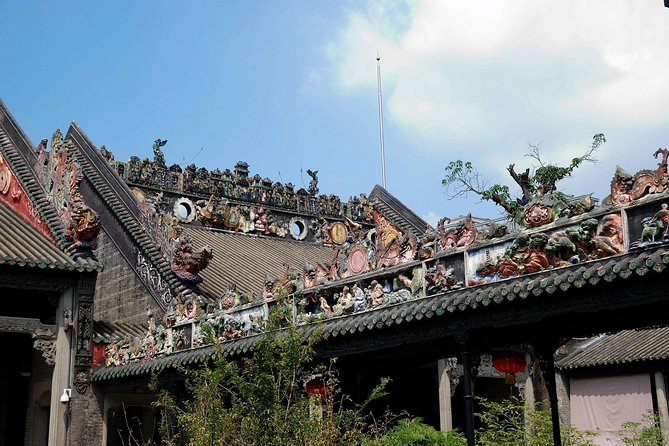
Inside, what you’re looking at is craftsmanship you can actually feel with your eyes. You’ll see fine wood, brick, and ivory carvings, plus elaborate beams and columns that show up as layers, not just decoration. This is one of those places where the details reward slow attention.
The building now houses the Guangdong Folk Art Museum. That matters because it turns the architecture into a guide for what Cantonese artistry values. You’ll find examples of Cantonese craftsmanship like traditional Chinese ink and embroidery designs, plus rare prints and ceramics. If you like the idea that Guangzhou is more than skyscrapers and busy streets, this stop is one of your best early signals.
Practical note: this is a full museum visit for about an hour. Go in with the mindset of browsing and letting carvings pull you toward specific themes, like how artisans worked in wood and how decorative patterns show up again and again across different object types.
The Nanyue King Tomb: 65 Feet Underground, Seven Chambers, 1,000 Artifacts
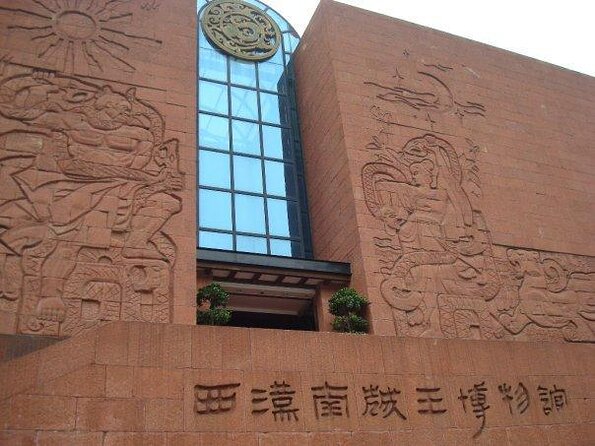
Next comes the star attraction for many history lovers: the Museum of the Western Han Dynasty Mausoleum of the Nanyue King. This is the royal tomb at Xianggang Hill and it sits about 65 feet (20 meters) underground. That underground distance creates a different mood right away. It feels less like walking through an open-air attraction and more like stepping into a preserved burial world.
You’ll learn that the Nanyue Royal Tomb complex dates back roughly 2,000 years and includes seven chambers packed with more than 1,000 burial artifacts. The scale is the point, and your guide will help you keep it straight so you don’t feel lost among objects and terms.
One specific detail that stays with you is the description of King Zhao Mo’s burial garment. It’s said to be made from more than 2,000 pieces of jade connected by silk thread. Whether you focus on the sheer count or the labor it suggests, it’s a powerful way to understand what “royal” meant in practice.
What I like about this stop is that it gives you a tangible link between Guangzhou and the broader story of early Chinese states. You’re not only looking at items, you’re learning why the tomb exists where it does and what kinds of artifacts were used to represent status after death.
Drawback to consider: you need to tolerate a more enclosed, museum-like environment as part of the experience. If you’re expecting an outdoor view or scenic walking, this one is about artifacts and explanation rather than scenery.
Six Banyan Temple and the Flower Pagoda, Three Copper Buddhas Included
After the tomb, you’ll head to Six Banyan Temple, also called Liurong Temple. It dates to 537, which gives you another long timeline marker right after the Western Han era. The temple’s main hall enshrines three copper Buddha statues, and here’s the detail that gets your attention fast: each statue is about 20 feet (6 meters) high, and they are described as the biggest copper Buddhas in Guangdong Province.
That scale makes a difference. You won’t be staring at tiny icons. You’ll be facing monumental forms, and your guide’s commentary helps you connect what you see to how this site is known for Buddhist cultural significance.
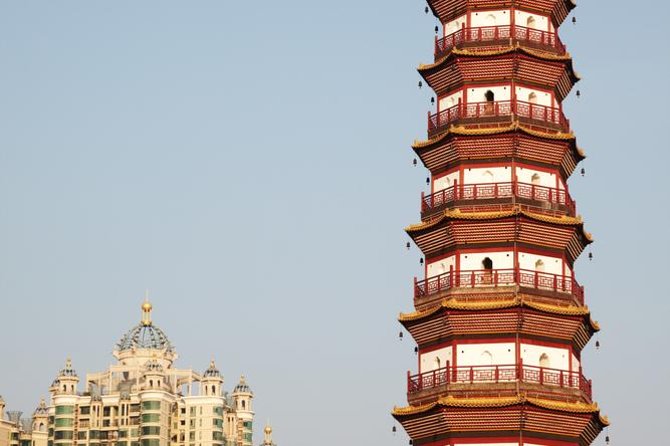
Then comes the Flower Pagoda, about 184 feet (56 meters) tall. You’ll stroll around it to see colorful exterior carvings and a decorative copper top piece cast in the Yuan Dynasty, listed as 1271 to 1368. That is a neat example of how a site can layer eras on top of each other, without requiring you to research for weeks.
If you enjoy photography, this is one of the better stops because the exterior carvings give you shapes and surfaces to work with. If you’re more into history, this stop also helps you understand religious influence that lasted for centuries in Guangzhou.
Tip: this is still a temple setting, so go with respectful pacing, keep your voice down, and let your guide set the context before you rush toward photos.
More lunches included in Guangzhou:
- Beijing: Mutianyu Great Wall Daily Tour with Ticket & Lunch
★ 4.9 · 1,190 reviews - Great Wall of China at Mutianyu Full-Day Tour Including Lunch from Beijing
★ 4.0 · 565 reviews - Xi’an: Exclusive Terracotta Army Tour & Local Family Lunch
★ 4.9 · 484 reviews - Mutianyu Great Wall and Summer Palace Small-Group Tour with Lunch
★ 5.0 · 316 reviews
Lunch Break: Cantonese-Style Meal You Can Actually Count On
Lunch is included, and it’s described as a Chinese-style lunch at a local restaurant. In practice, that means you’ll get a proper sit-down break instead of snacking your way through a long day.
I like that lunch is built into the timeline right after the tomb visit. After the underground museum atmosphere, you’re ready for something more ordinary and human scale. It also reduces the chance you’ll waste time hunting for food in a neighborhood where signage and menus might be harder to decode.
Now, a balanced note: the lunch experience can vary in how fancy the restaurant feels. One person described the lunch place as a little run down, while still saying the food was fine. So I’d think of lunch here as part of the cultural flow, not as a luxury dining event.
If you have picky eaters, tell your guide dietary needs when you meet. The tour includes lunch but food specifics beyond that are not guaranteed in the details provided, so communication is your friend.
Shamian Island: Colonial-Era Streets by the Pearl River
After lunch, you’ll go to Shamian Island. This is an oval islet around 0.3 square meters, framed by the Pearl River and White Goose Pool. You can feel the identity shift quickly. Shamian is known for colonial-era architecture, and it developed in the mid-19th century as an enclave for prosperous expat traders.
That history shows up in what you’ll see: Western-style mansions and churches that were built during that period, many of which are restored today. Nowadays, the island is home to fashionable cafés and boutiques, and it has that walkable, slower feel that makes it a smart way to end a history-heavy day.
I like Shamian because it gives Guangzhou a different face. Instead of only looking at one era, you get a reminder that trade and settlement changed the city’s streets and buildings, and that those changes can still be read in architecture.
Practical tip: don’t overpack your schedule with extra shopping right here. The charm is in the stroll and the architecture. If you want to shop, leave room, but don’t let it squeeze out your ability to just wander.
Shangxiajiu Pedestrian Street for Last-Hour Browsing
Your day also includes time on Shangxiajiu Pedestrian Street, a well-known walking shopping area in Guangzhou. It’s described as bringing long history into the experience of simply walking along the street.
This stop works best if you treat it as a casual browse rather than a must-shop mission. You’ll already have a full day of museums and temples, so this is your chance to shift gears. If you want souvenirs, snacks, or just a sense of everyday city life, this pedestrian street adds that layer.
If you’re not in shopping mode, you can still use it for people-watching and for street-level atmosphere. It’s also a good place to reset before heading back to your hotel.
Price and Logistics: Is $239 Fair for This Much Coverage?
At $239 per person, this tour isn’t the cheapest way to see Guangzhou. But I think it’s priced in a way that makes sense for the value you’re getting, especially if you want English guidance and private transport for multiple sites.
Here’s what you’re getting for that money based on the tour details: an English-speaking guide, hotel pickup and drop-off, transport by private air-conditioned vehicle, admission tickets included, and a traditional Chinese-style lunch. For an 8-hour route that covers several separate landmarks, that bundle often beats paying separately for guides, tickets, and transit time.
The real question is whether you will use the “private” part. If you want to save money and you’re comfortable getting around on your own by taxi, you could arguably DIY a cheaper version. But if you’d rather not spend your precious day managing directions, ticket lines, and explanation, this private structure is the thing you’re actually buying.
I also like that the tour includes admissions. In a day with multiple ticketed stops, that prevents the common travel annoyance of hunting for ticket counters or figuring out which lines move fastest.
What the Best Guides Add (Kevin, Nora, Jack, Frank, Robert and More)
One of the strongest signals in the feedback for this tour is guide quality. Names come up again and again, including Kevin Ling, Nora, Jack, Frank, Lili Lam, Robert, and Jan-Ming. The consistent theme is clear, helpful English and a style that makes the sites feel connected rather than random.
That’s why I recommend this tour even if you know some general Guangzhou history. A good guide helps you read the carvings at Chen Clan Temple without feeling like you need a textbook. They also help you make sense of what you’re seeing underground at the Nanyue King tomb, where details can pile up fast if you’re trying to interpret everything alone.
If you care about learning, you’ll appreciate the way these guides explain customs and what’s going on at each stop. And because it’s private, your questions do not get swallowed by a larger group schedule.
Practical Tips for an 8-Hour Guangzhou Day
This is an 8-hour tour that starts at 8:00 am with hotel pickup. That early start matters in a city that can get hectic later. It also gives you better odds of smoother traffic on the way between locations.
Walking is described as moderate, so plan on shoes that can handle uneven museum floors and temple paths. You’ll also want a light layer. Even when it’s warm outside, indoor spaces in museums and temples can feel cooler than you expect.
Bring simple travel basics: water if you prefer it, phone storage for photos, and a small bag you can keep under control. Food and drinks are not listed as included beyond lunch, so don’t count on snacks unless your lunch includes them.
If rain shows up, you still keep moving. Most of the key stops are indoors or have enough built structure to keep the day going without turning into a total washout.
Who Should Book This Tour, and Who Might Skip It
This private Guangzhou historical tour is a great fit if you:
- Want a structured day with hotel pickup and drop-off
- Appreciate the big arc of Guangzhou’s story, from ancestral halls and royal burials to Buddhist sites and colonial streets
- Don’t want to translate, route plan, and ticket-hunt across multiple neighborhoods
You might skip it if:
- You’re traveling on a tight budget and you’re comfortable DIYing with taxis
- You prefer long, unscheduled time in one area rather than a full-day route
- You dislike museum-heavy stops and prefer mostly outdoor sightseeing
Should You Book This Guangzhou Historical Tour?
My take: book it if you have limited time, you want the “most important places” covered efficiently, and you care about understanding what you’re seeing rather than just checking boxes. The combination of admissions included, private transport, and a Cantonese-style lunch makes it easier than piecing together your own day.
I would especially recommend it to first-timers in Guangzhou. When a city is huge and signage can be tricky, the guide’s explanations and the driver’s timing add up fast. The experience is also well supported by strong ratings, with an overall rating of 4.7 and a 92% recommendation score.
If you already know you want to roam freely and you’re confident navigating on your own, you might get similar sights with a cheaper plan. But if you want a guided, organized day that hits both the imperial and the modern-influenced faces of Guangzhou, this is a very solid choice.
FAQ
What time does the tour start, and how long is it?
It starts at 8:00 am and runs about 8 hours.
Is hotel pickup and drop-off included?
Yes. Round-trip hotel transport by a comfortable private vehicle is included.
Is lunch included?
Yes. The tour includes a traditional Chinese-style lunch at a local restaurant.
Are admission tickets included for the stops?
Yes. Admission tickets are included.
Is this a private tour?
Yes. It’s private, meaning only your group participates.
How much walking is involved?
There is a moderate amount of walking, so comfortable walking shoes are recommended.
Can I cancel and get a full refund?
Yes, free cancellation is offered. You must cancel at least 24 hours in advance for a full refund.
Latest reviews from Guangzhou
- Foshan Cultural One Day Tour including Ancestral Temple & Nanfeng Ancient Kiln★ 4.0 · 5 reviews
- Private flexible Guangzhou City Sightseeing Tour with Dim-Sum Tasting★ 5.0 · 5 reviews
- Guangzhou: Textile Hub and Garment Factory Half-day Tour★ 5.0 · 5 reviews
- Seven Star Crag and Dinghu Mountain private day tour from Guangzhou★ 5.0 · 5 reviews
- All Inclusive Kaiping Diaolou Heritage Private Day Trip from Guangzhou★ 5.0 · 5 reviews
- Kaiping Private Day Tour From Guangzhou★ 4.8 · 6 reviews
- Private Guangzhou Night Tour with Canton Tower and Pearl River VIP Class Cruise★ 5.0 · 6 reviews
- Skywalk Glass Bridge Waterfall Mountain Ancient Cave Private Tour★ 4.5 · 6 reviews
Historical Tours, compared.

Beijing Historical Tour II including Summer Palace, Lama Temple & Panda Garden
Read our review →
Beijing Historical Tour I – Forbidden City, Tiananmen Square & Temple of Heaven
Read our review →
Tour of Jewish Shanghai led by a Jewish History Expert
Read our review →
Beijing Historic City Guided Walking Tour + Calligraphy Creation
Read our review →
All inclusive Two-Day Xi’an private Heritage Tour
Read our review →
Xi’an Full Day Sightseeing Tour – Shaanxi History Museum, Big Wild Goose Pagoda, Ancient City Wall
Read our review →
Shenzhen History , Culture & Scenic + (Drone Delivery) tour
Read our review →
Bell and Drum Towers Entry Ticket – Historic Landmark
Read our review →Browse the lists this tour appears in